Marriage, Self-Sufficiency, & Disability

Written by Madison Bigelow

  • A title slide for the presentation: Marriage, Self-Sufficiency, & Disability
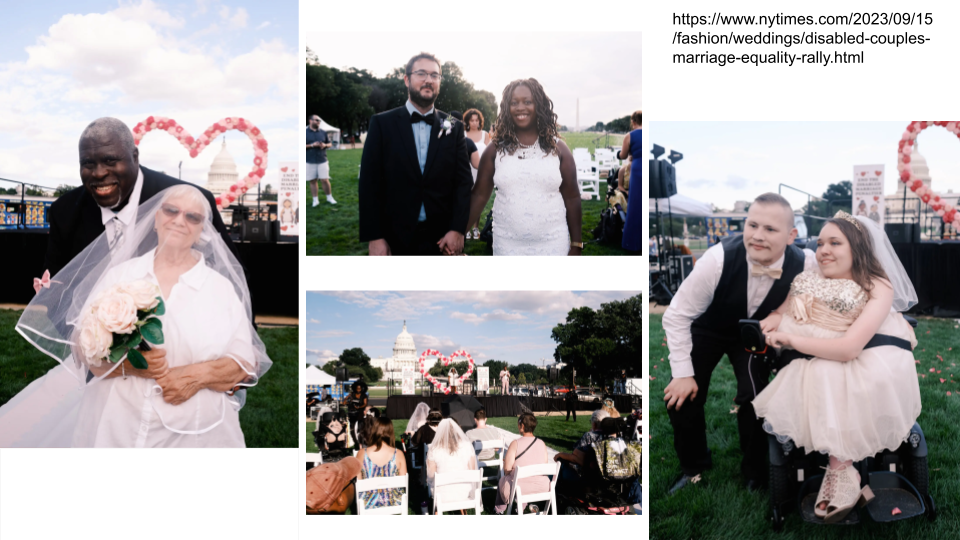
  • Slide Title: Disability Marriage Equality Now Rally. The following is a direct quote taken from a linked New York Times source: "According to the Disability Rights Education and Defense Fund, the nonprofit group that organized the rally, around 7.6 Americans recieve S.S.I. About a million more are classified as disabled adult children, a designation that qualifies recipients for Medicare and a small monthly Social Security stipend. They are also at risk of losing some or all of their benefits, if they become their partners' legal spouses"
  • Four images of couples on their wedding days. In the leftmost image, a veiled White bride poses with a Black groom. She is noticeably shorter than him, and is holding a bouquet of pink roses. The middle images depict another interracial heterosexual couple smiling at the camera (top) and a shot of a wedding venue (bottom); guests look up at a stage featuring a heart-shaped archway of pick roses. The right image depicts another White heterosexual couple. The groom leans forward to be at eye level with the bride, who is a little person sitting on a motorized wheelchair.
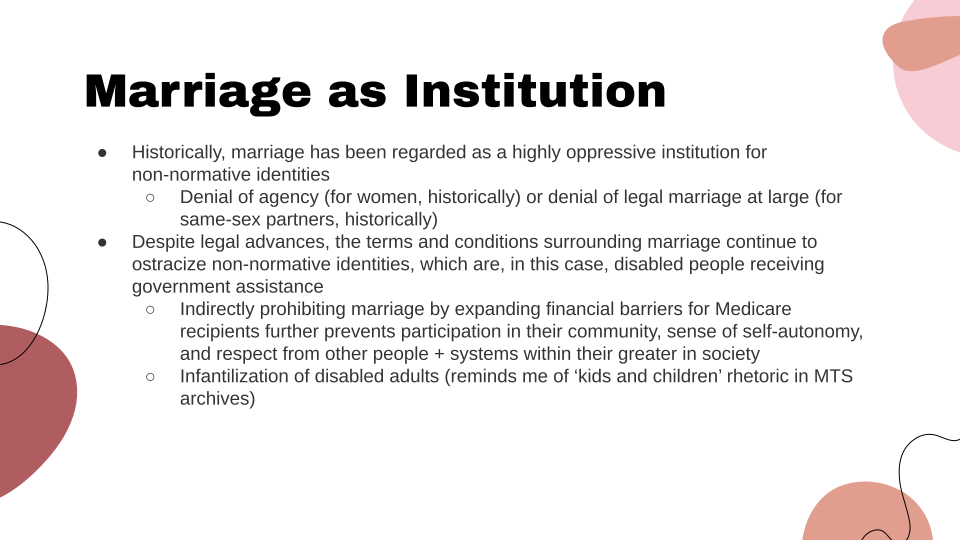
  • Slide Title: Marriage as Institution. Historically, marriage has been regarded as a highly oppressive institution for non-normative identities: denial of agency (for women, historically) or denial of legal marriage at large (for same-sex partners, historically). Despite legal advances, the terms and conditions surrounding marriage continue to ostracize non-normative identities, which are, in this case, disabled people receiving government assistance. This includes: indirectly prohibiting marriage by expanding financial barriers for Medicare recipients further preventing participation in their community, sense of self-autonomy, and respect from other people + systems within their greater society. And: Infantilization of disabled adults. Author note: reminds me of 'kids and children' rhetoric in Mansfield training school archives.
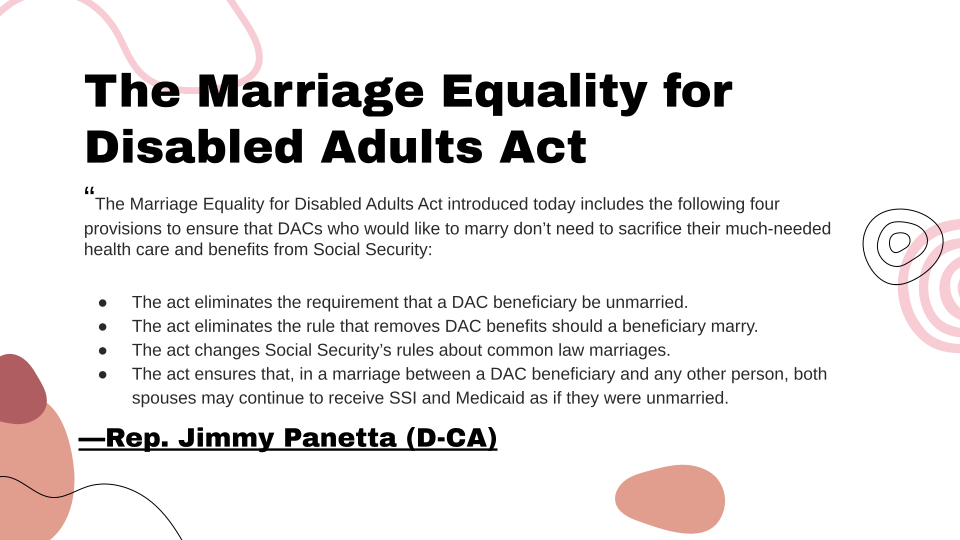
  • Slide Title: The marriage equality for disabled adults act. This slide contains a long quote attributed to representative Jimmy Panetta (D-CA): "The marriage equality for disabled adults act introduced today includes the following four provisions to ensure that DAC's (Disabled adult children) who would like to marry don't need to sacrifice their much-needed health care and benefits from Social Security. 1: The act eliminates the requirement that a DAC beneficiary be unmarried. 2: The act eliminates the rule that removes DAC benefits should a beneficiary marry. 3: The act changes Social Security's rules about common law marriages. 4: The act ensures that, in a marriage between a DAC beneficiary and any other person, both spouses may continue to receive SSI and Medicaid as if they were unmarried.
  • Slide title: Why has this taken so long? Why is the ability to marry and have access to government assistance mutually exclusive? The author provides a list of hypotheses: 1: prevent the 'threat' of ruining 'marriage sanctity' by those of non-normative identities. 2: Prevent the economic participation of disabled adults as a 'familial' unit plus benefits that come with marriage status. 3: Deny disabled adults their 'adulthood' slash self-sovereignty slash agency slash autonomy slash right to make decisions for themselves. The author elaborates that this hypothesis is evident in the fact that even in Panetta's proposed bill, they're still called Disabled Adult Children. 4: Invalidate personhood to disabled adults who've been historically marginalized. 5: Draw an impermeable boundary between disabled and nondisabled individuals. The author elaborates on this hypothesis: either you are disabled, need government assistance, and cannot get married for financial reasons, or you are not disabled enough or at all, will not receive government assistance, and are allowed to get married. A final hypothesis or conclusion: add another impressive bullet point to America's long resume of human rights abuses.
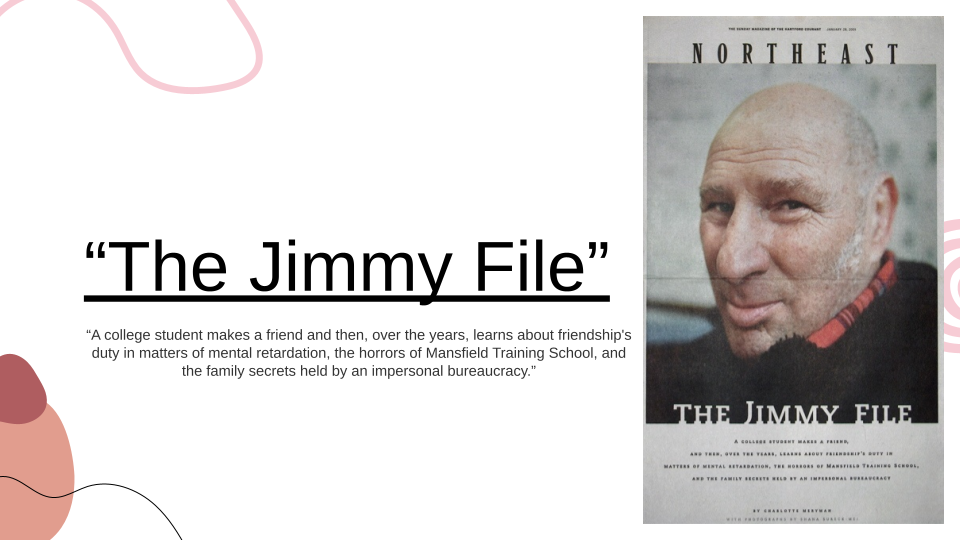
  • The Jimmy File. This slide contains a quoted description of the Jimmy file video: "a college student makes a friend and then, over the years, learns about friendship's duty in matters of mental retardation, the horrors of Mansfield Training School, and the family secrets held by an impersonal bureaucracy." On the righthand side of the slide is a copy of the movie poster for "the Jimmy File," with a close-up portrait photograph of a White man approximately in his forties dressed in a red checkered scarf and black coat. The man is looking slightly sideways at the camera. The poster additionally contains the movie title and the previously quoted description.
  • This slide contains a long quote, presumably from the film: "About a year after I met him, Jimmy and Mary Tarquinio, a resident in his group home, got their own apartment on Zion Street, abutting the Trinity campus. Cheerful and easygoing, Mary is a natural counterpoint to Jimmy's intensity. He's easily agitated; she's hard to ruffle. He talks constantly; she listens and laughs. She even balances him out physically. Where he is a wiry bundle of sharp angles, she is a softly contained square, tiny and plump. Mary is the one person who can tell Jimmy to knock it off when his ramblings and repetitions get to be too much. She also could read, write and cook--skills Jimmy lacked and desperately needed to live on his own. At 59, she was 20 years his senior, but somehow, that never seemed to matter. He clearly adored her, and in time it transformed him." On the left of the side is an image of Jimmy and Mary cuddling on a large grey couch.
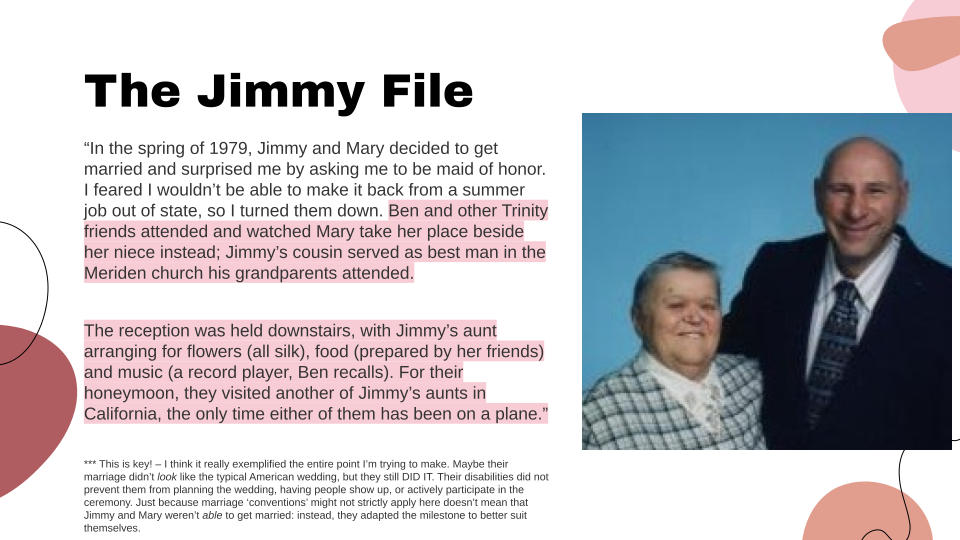
  • This slide includes another quote from the film: "In the spring of 1979, Jimmy and Mary decided to get married and surprised me by asking me to be maid of honor. I feared I wouldn't be able to make it back from a summer job out of state, so I turned them down. Ben and other Trinity friends attended and watched Mary take her place beside her niece instead; Jimmy's cousin served as best man in the Meriden church his grandparents attended. The reception was held downstairs, with Jimmy's aunt arranging for flowers (all silk), food (prepared by her friends) and music (a record player, Ben recalls). For their honeymoon, they visited another of Jimmy's aunts in California, the only time either of them has been on a plane." On the right of the slide is a picture of Jimmy and Mary, posing together in fancy clothing. Jimmy is wearing a black suit and patterned tie. He stands a head taller than Mary. Mary has short grey hair and is wearing a plaid patterned blouse. At the bottom of the slide is an author's note: This is key! -- I think it really exemplified the entire point I'm trying to make. Maybe their marriage didn't look like the typical American wedding, but they still DID IT. Their disabilities did not prevent them from planning the wedding, having people show up or actively participate in the ceremony. Just because marriage 'conventions' might not strictly apply here doesn't mean that Jimmy and Mary weren't able to get married. Instead, they adapted the milestone to better suit themselves.
  • This slide includes another quote from the film: "Jimmy and Mary moved into their first-floor efficiency in the Alfred Plant Senior Housing when it was brand new; they were made eligible by Mary's age, then 66. There was a time when Jimmy was eager to be rid of such help. Now, he appreciates it for what it is: a resource that can help him build an independent life. As a disabled person, he receives monthly Social Security and federal and state disability checks, which cover his expenses. His mother sends a little money every month for extras, like going out to eat. For healthcare, he has Medicaid and Medicare. In addition to Sharp and several other DMR employees, he and Mary also have the support of Connecticut Community Care Inc. and the state Office of Protection and Advocacy for Persons with Disabilities. Jimmy is a master at negotiating the system to get the benefits he and Mary need." The right of the slide depicts Jimmy in front of a business, sweeping the sidewalk with a broom. An author's note: Even in a world where Jimmy and Mary did not get married, these benefits still weren't enough to completely support them. They helped, but they still needed to collect a myriad of different aids slash supports and Jimmy still sought to bartering around the neighborhood.
  • “ON A SUNNY AFTERNOON last spring, Jimmy introduced me around at what he likes to call “Lundquist Plaza,” the small strip of family-owned shops across the street from their Farmington Avenue apartment. At the Dairy Plus convenience store, he greeted familiar customers with a buoyant, “Hey, how you doing?” and a wave of his good hand. “See,” he told me proudly. “Everybody know Jimmy Lundquist.” Jimmy has worked out an informal bartering arrangement with the owners, Daksha and Prakash Thaker, sweeping and picking up trash outside the store in exchange for free coffee, soda, an occasional doughnut, or lollipops for the neighborhood kids. He told me he keeps an eye on some of the older children for their mothers, calling them if the kids are smoking or skipping school. Next door, at the West Hartford Laundromat, Jimmy saved his biggest greeting for owner George Odelius. Soft-spoken, with a kind face and easy manner, Odelius, his wife, Vina, and grown daughters have welcomed Jimmy and Mary into their family, including them in holiday gatherings and lending a hand when needed. It’s a friendship, like so many of Jimmy’s, built on moments accumulated over years—daily chats over morning coffee and afternoons shooting the breeze around the shop. Jimmy sweeps the sidewalk each day, and has taken to stopping by on Sundays, the one day Odelius isn’t there, to check on the place and straighten up. In exchange, Odelius does his dry cleaning for free. During the long months of Mary’s hospitalization, Odelius did all his laundry for free, and Jimmy called him every night to talk.”
  • Slide title: Understanding Self-Sufficiency. 1: Universal Declaration of Human Rights: From discrimination, 2. To recognition before the law, 6. To equality before the law, 7. To marriage and to found a family, 16. To social security, 22. 2: Are current conditions sufficient to deem the situation a human rights violation for DAC's? Under UDHR... Yes. Morally, while much more subjective, ... also feels like a yes.
  • Slide title: Understanding Self-Sufficiency: The Jimmy File as a model: Independent living for DAC's doe not mean individuals are completely severed from institutional or community aid. Survival is a negotiation between social symbiosis and federal support. Support from government and marriage do not need to be mutually exclusive. DAC's are already hyper-aware of income they receive as individuals as to not impact federal medical benefits. This connects to Institutional disabling of already-disabled individuals: work limited hours slash jobs to retain S.S.I. payments, prohibit full economic participation in their community, impact denial of marriage to further prevent social slash political slash economic participation.
  • Slide title: What does The Jimmy File prove? 1: Disabled adults can and do live independently, all the time. 2: Alternate means of living and survival; Jimmy (and Mary's) life does not mimic the typical 'American' life but also, how could it after you've been institutionalized and dripped into 'mainstream' society with few means of support? 3: Challenges ideals of capitalism and the nuclear family. Productivity presents differently; the notion of the family presents differently. Alternative means of living may mean being unable to participate in or benefit from larger capitalist systems at play, Jimmy subverts conventions of livelihood.
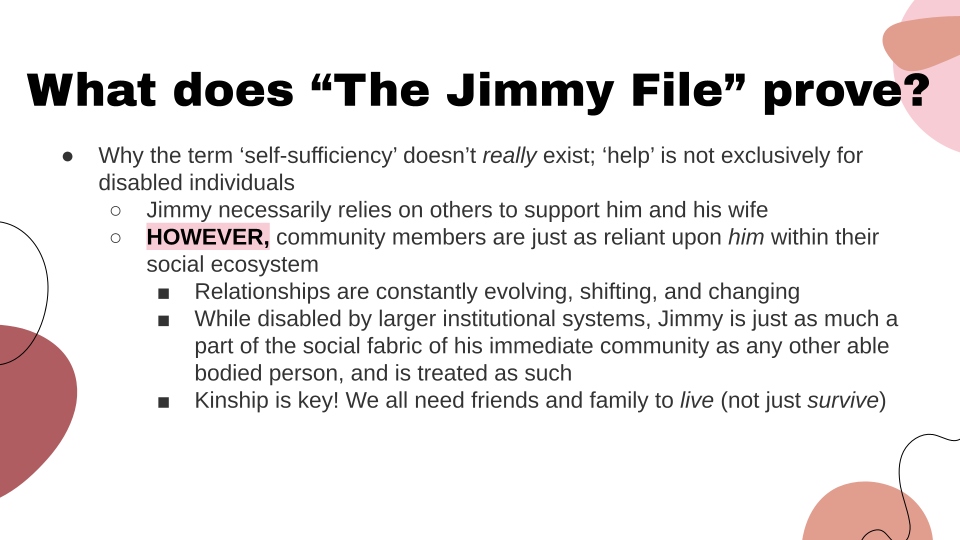
  • Why the term "self-sufficiency" doesn't really exist; 'help' is not exclusively for disabled individuals. Jimmy necessarily relies on others to support him and his wife. However, community members are just as reliant upon him within their social ecosystem. Relationships are constantly evolving, shifting, and changing. While disabled by larger institutional systems, Jimmy is just as much a part of the social fabric of his immediate community as any other able bodied person, and is treated as such. Kinship is key! We all need friends and family to live, not just survive.

This slideshow presentation contains alt text descriptions for text and images present on each slide. Additionally, a full transcript of the slide text can be downloaded here:

Author’s note: This presentation was originally created as a part of an annotation series for the “Doing Disability Studies in the Humanities” graduate course that I took with Dr. Brenda Brueggemann. In this course, we were prompted to select pieces of media (whether those be written texts, films, current events, pop culture artifacts, etc.) and analyze them through one/many lenses of disability theory. 

I had originally read “The Jimmy File” while doing research about the Mansfield Training School, a state-led psychiatric institution located within walking distance of the University of Connecticut. Jimmy Lundquist had once been a resident at the Mansfield Training School; this “file,” written by Charlotte Meryman, records one instance of what life looked like for residents post-institutionalization (if they were ever discharged from the facility). While this article was originally published in The Hartford Courant in 2001, I was immediately reminded of Jimmy and his experiences when I came across a more recent article, titled “For Disabled Couples, a Plea for Marriage Equality,” released by the NY Times in September 2023. 

The state, in large part, not only plays a relatively large role in how marriage, romance, and union are understood within mainstream American culture, but also how disabled individuals do and do not fit into “standard” family models. This presentation was an attempt to understand how healthcare, marriage, and disability intersect at various points to enable or prevent disabled people from achieving what are commonly accepted as life milestones, like a wedding or marriage. Specifically, after understanding healthcare policy as a key determinant in whether or not a disabled person is considered ‘fit’ for marriage (either explicitly or indirectly), it identifies Jimmy’s relationship with his wife in the later years of his life as a successful model for what marriage could look like for two disabled adults.

Leave a Comment