
Written by Elisa Shaholli, Mina Keleş, Sude Kılınç, Hayel Yelek, and Duru Urer
Elisa: Instructor’s Introduction
For the past six months, I’ve been living in Izmir, Türkiye as part of the U.S. Department of State’s Fulbright Program. For Fulbright, I’m completing the English Teaching Assistantship (more commonly known as the Fulbright ETA) where I’ve been placed at a university here in Izmir. I teach English as a foreign language to university students of all English levels (Beginner, Pre-Intermediate, and Intermediate), with an emphasis on Intermediate level students.
When preparing and planning for Fulbright, there were common topics and concerns I had swirling around in my head: Would I like my city placement? How would teaching go? What would day-to-day life look like? What would I do about homesickness? How could I tackle a desire to both adapt to a different culture while retaining and teaching about my own?
A major curiosity I had was about disability identity within the new community and cultural landscape that I would be entering. What I was especially interested in was how disability was discussed in the public sphere, treated in interpersonal connections, and the social and political landscape surrounding disability. While I can chronicle my current experiences as an individual with type one diabetes living and working in Turkey at a higher education institution, I have been particularly interested in the topic of disability here from local perspectives. As someone who’s only been living here for a couple of months, I have a limited amount of information surrounding this topic.
As a result of this, I wanted to learn more from those around me on what disability culture and identity entails here in Turkey. I remembered how undergraduate research had really helped me learn about disability culture and how to express myself while I was at UConn. Research had a long-lasting impact not only on the way I now view topics of interest and investigate them, but also in the way I approach self-expression. While undergraduate research was a topic that I had heard about at UConn and from other U.S. college students, undergraduate research is not commonly conducted at many Turkish universities. I and another Fulbright ETA had a talk about American institutions of higher learning with students at my university’s speaking club, where I discussed my own college experience and the importance of undergraduate research throughout my four years. The feedback I was given by students was how different the American and Turkish college experience looked: undergraduate research is not discussed much, if at all, here.
Combining the desire to learn about disability in Türkiye from local, authentic resources; an interest to get more involved in my university and build closer relationships with my students; a desire to spread information to others, especially individuals interested in disability internationally and in Türkiye; and the desire to get interested students involved in Disability Studies, I shared the DAC Blog with my students. I presented the DAC Blog to two of my Intermediate classes in addition to my Intermediate Speaking Club. In my presentations, I let the students know that I was interested in writing a post about disability in Türkiye, and that as an American writing from a foreigner’s perspective, it was important to me that local voices share their perspectives on this topic, especially considering this blog is read by a heavily American audience who may not have much knowledge on Turkey or Turkish culture. If any students were interested in getting involved in undergraduate research and the topic of disability in Türkiye, they were encouraged to reach out to me.
Below you will find samples of the presentation I shared with students when explaining the DAC Blog and this post’s original idea:
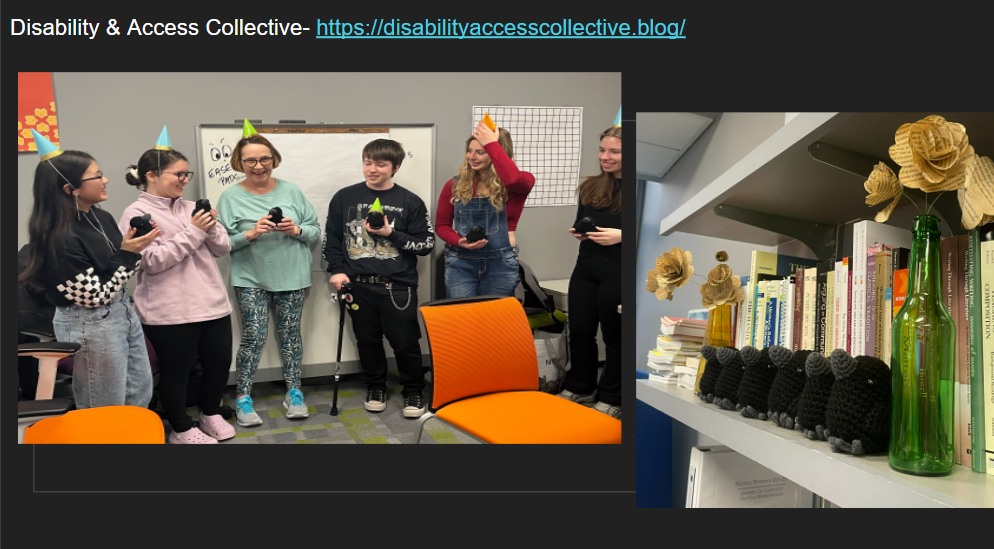
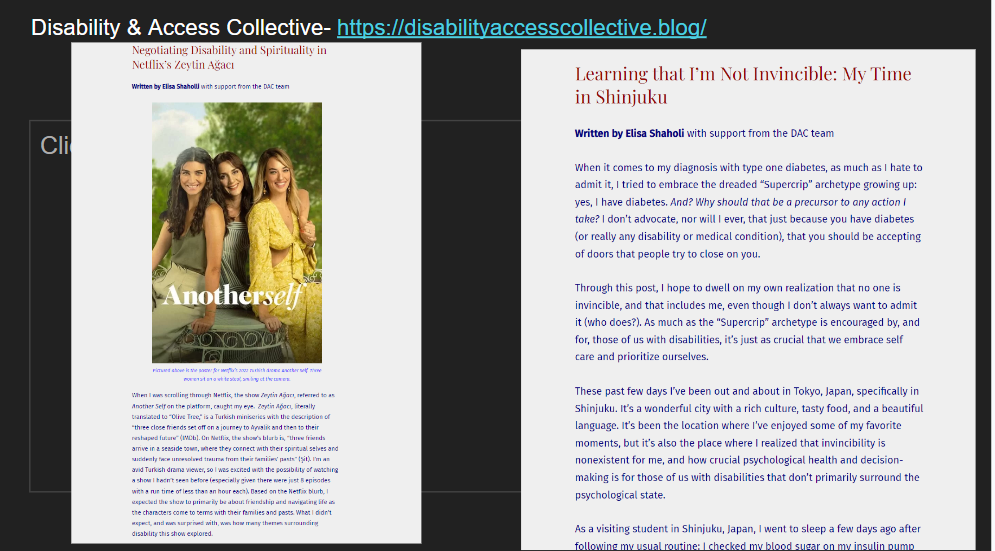


Other slides included further details, my contact information, and listed potential benefits that students may encounter if they get involved (for example, if students were interested in improving their writing skills, this could be an outlet for doing so, alongside the benefit of sharing one’s personal story in regards to disability). I had a number of incredibly talented and motivated students who were interested, which you will read and learn about in this blog post. With an assortment of different interests, personalities, experiences, stories, and goals, you will find each of us has focused on different aspects and themes surrounding disability in Turkiye. You’ll find:
- writings surrounding health services and patient-doctor experiences by Mina;
- medications and their relationship with economics by Sude;
- an analysis on gender-related issues by Hayel; and
- a personal reflection on living with giftedness and ADHD by Duru.
We hope that through reading this blog post and the assortment of writings here, you will learn a bit more about disability and Disability Studies in a Turkish context.
Mina: Writings surrounding health services and patient-doctor experiences
I am interested in this blog because my teacher said that you can write anything about your ideas in this blog and I want to talk about the relationship between patients and doctors in Turkey. This relationship is hard for both of them because of a lot of reasons. I will explain these reasons with credible sources and my point of view.
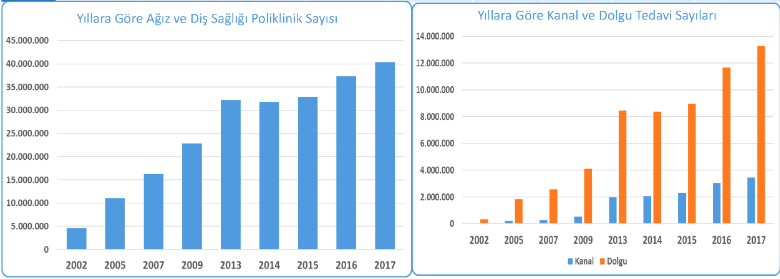
First of all, I want to talk about appointments. We have a system about making appointments with the doctors in the government/state hospitals. This system works like this: we only have fifteen minutes for an appointment. Fifteen minutes are not enough but there are so many people that live in Turkey, so we can’t provide fair health services for everyone. Sometimes we can’t find any appointments in the city center because the government tries to open new hospitals, but we have distorted urbanization in Turkey. We just have places for new hospitals far from the city center. In addition to this, oral and dental health hospitals are always busy too. Making an appointment at the dentist is more challenging than making one with a doctor. Over time, we will have more dental problems because of genetically modified foods. I have added two tables about this situation from the Turkish Dental Association.
Reference 1: Number of Oral and Dental Health Clinics by Year and Number of Canal and Filling Treatments by Year in Turkey
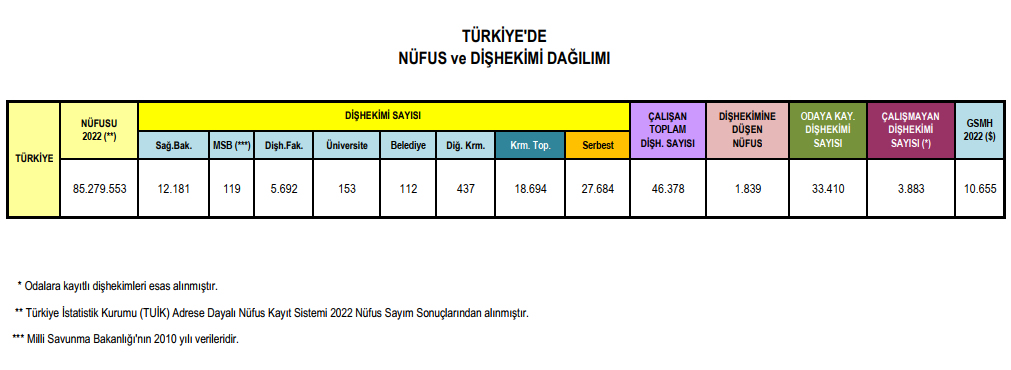
Reference 2: Population and Dentistry Distribution in Turkey
Reference 3: Number of Dental Faculties in Turkey, 1908-2023
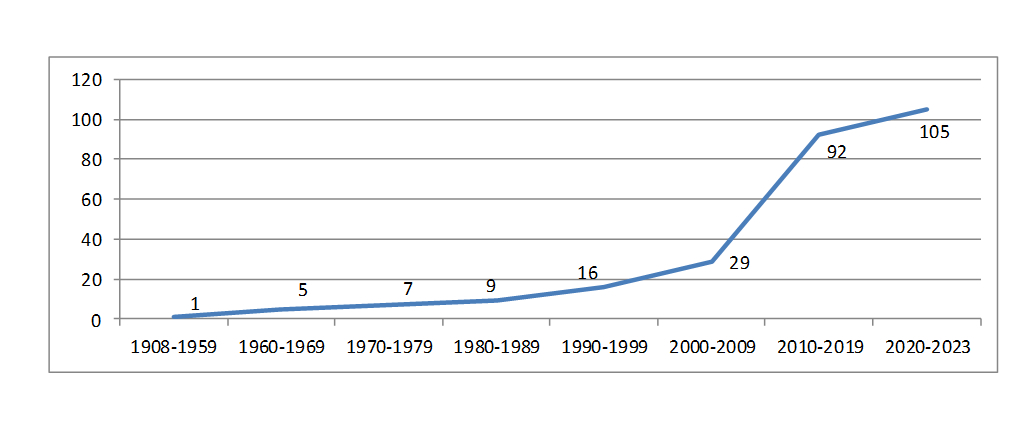
Now that we have 105 dentistry faculties in Turkey, this sudden increase has negative side effects. The most important negative side effect is the lack of education. Some dentistry departments just have a few labs, and they share classes with students from other faculties.
Despite everything, students are trying to become good dentists. Medical and dentistry students studying in Turkey’s universities believe in making the world a better place: even if there are no other doctors in the world, they will be able to take care of problems because of their departments thanks to their teachers. Sometimes when all the hard education is finished, and they become doctors, they encounter violence from patients because of the difficulties in the system that I mentioned. We have a lot of news related to this topic, but I just added four news stories which you will find below. I am a student of a dentistry faculty in İzmir. I am so happy and proud about who I am, but I feel anxious and sad sometimes because of the difficulties that come with being a doctor in Turkey, especially being a female doctor. I know similar things happen all over the world, but I live in Turkey. I hope everything will change one day, and Turkey’s doctors can feel comfortable at work.
A Variety of News Stories related to Violence against Doctors and Dentists in Turkey:
Hamile doktora şiddet: Gebeliği tehlikede
(Violence against pregnant doctor: Her pregnancy is in danger)
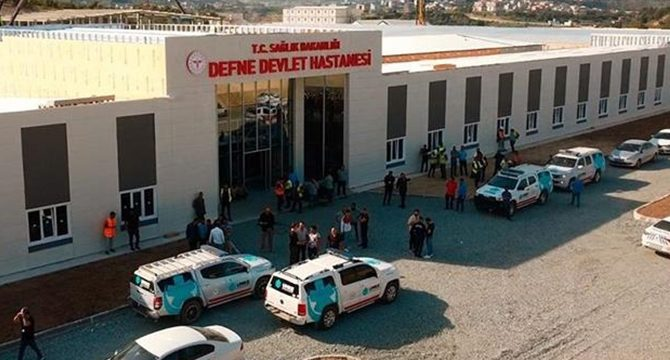
Konya Şehir Hastanesi’nde silahlı saldırı: Doktoru vurup intihar etti
(Armed attack at Konya City Hospital: Someone shot the doctor and then committed suicide)

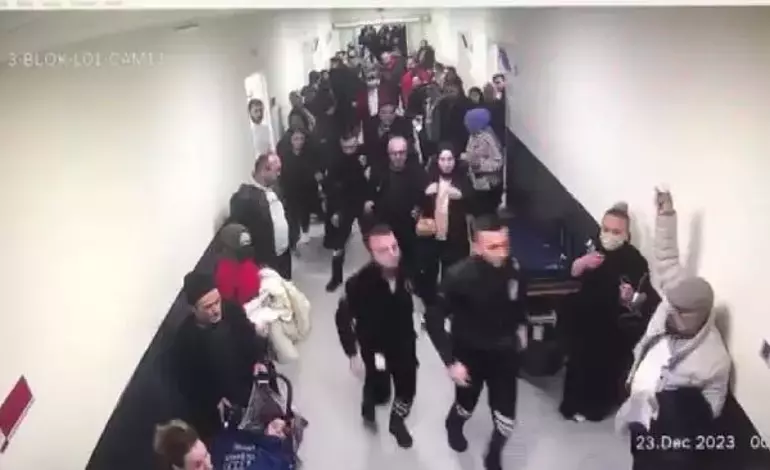
‘Saçıma dokundun’ iddiası! İstanbul’da hastanede doktora saldırı – Son Dakika Milliyet
(‘You touched my hair’ claim! In Istanbul, in a hospital, a doctor was attacked)
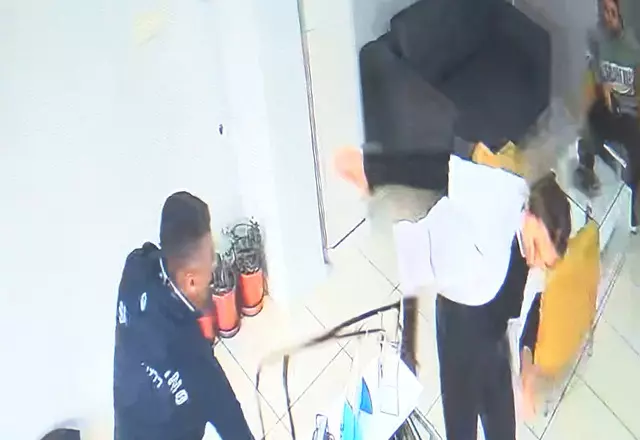
Aldığı tedaviyi beğenmedi diş hekimine saldırdı! ‘Dudağıma ne yaptınız!’ – Son Dakika Haberler
(He didn’t like the treatment he received and attacked the dentist! ‘What did you do to my lip!’)
Secondly, I will continue with addressing the working hours and the salaries of doctors. A few months ago, doctors had 48 hour shifts, but the government eventually noticed this is too much, and they put some prohibitions on it. There are these prohibitions, but nobody cares. People are officially treating intern doctors like robots. They work all the time in the hospital, and they earn almost nothing. When calculating the salaries of intern doctors, they are paid the same as the minimum wage. For the first half of 2024, the salary of an intern doctor at state universities was determined as TL 17,002 per month, and the salary of an intern doctor at foundation universities was determined as TL 3,583 (Reference 8). The exchange rate between USD and TL as of February 25, 2024 is around 1 USD to 30 TL for reference. State university wages then would be around $566 and foundation universities $120. In daily life, this money is not enough for living. Everything is more expensive in Turkey than most other countries, so the minimum wage is below the hunger level. It would take twenty years working your life away as a doctor, your youth no longer existing, for you to earn a good salary. Medicine and dentistry are less preferred now than in the olden times in Turkey because of this. Young, hard working people are interested in engineering now, and some doctor candidates are thinking about working abroad. I think this is such a painful situation: I want to work for everyone’s health, but I can’t consider myself a good doctor if I can’t help the people of my own country. Would doctors abroad who are Turkish like it to be like this? I don’t think so, but they show the entire world we have good, successful doctors.
The last part of my topic will be about solidarity in hospitals. Despite all the bad events, our local doctors do try to help nurses, assistants, anesthesiologists, and people who work in hospitals. They live in a different world from many other people. They care for patients more than themselves. Sometimes on the same day, they have to see life and death. For instance, they can see the birth of a baby, but they can also lose a patient. They have to be cool and quick every time. They mustn’t get tired. Therefore, we understand doctors have material and spiritual difficulty in Turkey.
People living in Turkey are increasingly losing their respect for doctors and starting to treat them badly. If the situation continues like this, maybe one day it will be more difficult for us to reach them. We should know their value while we still have them. The most important thing in the world is maintaining our health, and the doctors in our lives fight off diseases like soldiers. We shouldn’t help the enemy. No matter where we are in the world, if we are alive, thanks to doctors, we have to fight for their living standards, their working lives, their emotions, and the list goes on. I think the situation is not hopeless even though there are bad sides. They are still being children’s superheroes. They save lives and also save the lives of the people we love so we are not alone, thanks to doctors again. One day I am going to be a dentist in Turkey, so I have many reasons to write this, but also I want to explain that every person has to give doctors the treatment they deserve for their dedication to their career.
All References: 1; 2; 3; 4; 5; 6; 7; 8
Sude: Medications and their relationship with economics
As a Pharmacy student in our country, acquiring medicine is too hard especially considering the prices. It’s also a huge problem for people with disabilities and patients because they can’t afford the medication. I want to mention this topic as a citizen who lives in this country (Turkey).
Firstly I want to talk about my brother. He has a disability. His nervous system doesn’t do its job. He has Fredereich’s ataxia, and now maybe he doesn’t have that much difficulty, but day-by-day he will lose the ability to walk, and maybe even talk. In the beginning it was too hard to accept. Like there’s nothing you can do, and your body is constantly working against you. All you can do is get used to it. I was preparing for my university exam when I learned about my brother’s disease. It was hard to take in. At that moment I said I am going to be someone useful for him. Because I should do something for every person who struggles with disabilities, especially my brother. I know I am just one person, but I know if people are more sensitive about it, things are able to change.
There are treatments and medicines all around the world, but in general, they are so expensive, and patients can’t afford them. You can see families who want help for their children. While you’re walking in the metro, you can see these families, and you can give some money, but that’s not enough for anyone. As time goes by, medical technology has developed and medicines have become accessible for some diseases, but the pharmaceutical industry has some issues like competition, global health trends, and regulations. I mean in the pharmaceutical market industry, pharmaceutical companies try to make more money and become more prestigious. They make treatment into a race even if it’s all about people’s health.
As you can see in the references (References 1-3), people are victims and the patients want help from citizens because pharmaceutical companies and health policies are not helping that much. For example, in the article Anne ve babası işitme engelli olan Yusufhan’ın SMA mücadelesi, this article discusses how people make campaigns to raise money for medical treatment. If you want medicine from abroad, authorized people in the Ministry of Health say we should get permission from doctors, and then doctors say they don’t have that much competency, and at the end of the day we can’t get the medicine. At least in our case, it happens like that.
References 4, 5: Periodic Euro Value (DAD) Information Applied to Pharmaceutical Prices
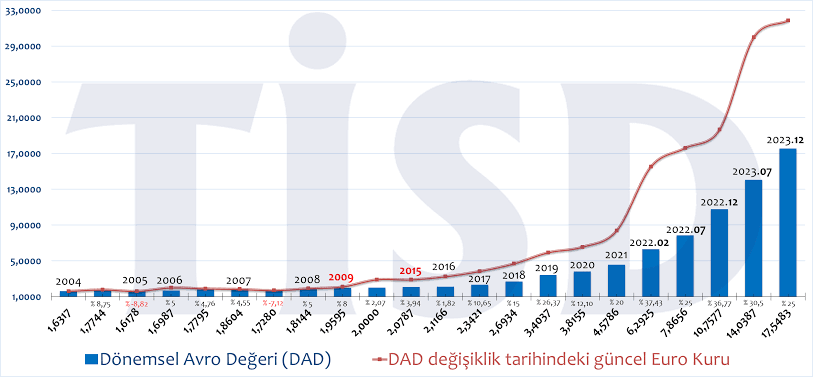
In conclusion, in Turkey this is a big problem for those who have disabilities who should take drugs. I hope healthcare becomes more accessible. I wish health for everyone. Thanks for your attention to this writing. I hope I can make you think about this topic more.
Hayel: An analysis on gender-related issues
Being a woman is the hardest thing in Turkey. Like other countries, we have gender issues. Also, our society comes from a patriarchal structure, but our roots are not like that. Our ancestors always valued women. When Turks accepted Islamism, some of them started to pretend to be more like an Arab-oriented culture. I think our problem is increasing from here. Some Turks believe that Islamism is related to Arab culture, but I don’t support this idea.
I don’t think we are comfortable as women because of the law. The law does not protect us enough. We must fight for our justices. Some people don’t accept our struggles. For example, they think when a woman goes out during the late hours and is harassed, “What was she doing at that hour? Why was she wearing a skirt?’’ Don’t be ridiculous. I wear what I want. Do these reasons make the harassment normal? In other words, if the government won’t accept women being able to dress themselves freely or make an effort to protect women, their conservative norms penetrate us, and then the situation becomes common by normalization.
Think about being born in Turkey as a woman. She already has responsibilities such as cooking, cleaning the house, being a mom, etc. since a young age. Why don’t we discover our skills like a boy can? “She who lives at home is called a girl” (someone who doesn’t leave the home). It is thought that we are very interested in our homes, and we can’t do much more. We can do jobs. We are not furniture. We have two legs, two arms, and two eyes like a boy. I can do everything that a boy can do. Why do they just say these words about us? I think gender is a discriminator. If a woman works her own job, the man must share the housework. Also, we don’t have to work in order to share housework. We’re living in the same place. Why just us? I can’t understand, and I will never understand. Men are not superior to women.
In the past, Turkey was safer but now we feel more fear. When we are walking, drinking coffee, going to school or anywhere, we can be harassed or followed by anyone. We don’t know. How do we know? I want to share my experience. I’m just 19, and I was harassed more than once. I’m not sure, but somebody might have been following me. I was returning from work at 11 PM. I was feeling so tired and had been waiting for my bus. My bluetooth had opened because I was listening to music. So, my Airdrop also opened. I didn’t know who sent me a photo. The photo suddenly was displayed. It was a nude. Fear undertook my body. I was feeling terrible. Probably, after this situation, we used the same bus. I was feeling someone glance at my body. This is just one example. Also, a man kissed me in a lift when I worked. He was older than my dad. The man was dismissed. I couldn’t tell my family because, “What will people say?’’ I wanted their support. My colleagues were always with me. I wanted to tell the police, but I was sure absolutely nothing would be changed. We saw the news. A lot of female students are harassed when they are going to school by bus like me. My first experience of this was when I was 13. We were just wearing school uniforms. Why? As I said before, the police just talked and never helped us. Also, can’t we wear a skirt?
I think this is a disability because of society’s mentality. Even though being a woman itself is not a disability, all the events that we go through make it feel like a disability. Because there are many struggles we have to deal with in society since we are women.
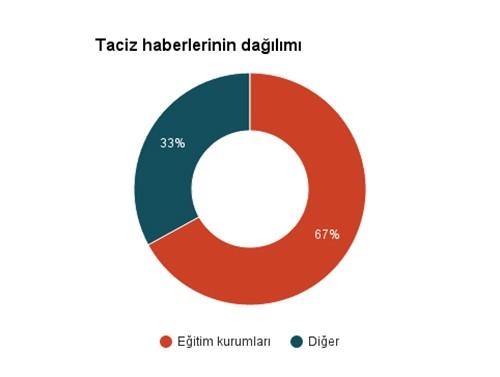
Reference 1: Distribution of Harassment
Secondly, Turkey has a lot of homicide and rape occurrences. Issues with the law show itself to us. It is too complicated. Women are murdered wildly because of these patterns. Sometimes some women are raped before they are slaughtered. It sounds terrible.
“Why don’t you love me?’’
“Why did you break up with me?’’
“But you laughed at me.’’
“You were wearing a skirt, it is your mistake.’’
“You are always mine.’’
“How did you refuse me?’’
Moreover, the killers sometimes don’t even know these women. We know that a man killed a woman once with a sword for no reason in İstanbul (Reference 2). Justice handles this, but if it was enough, these occurrences wouldn’t continue. I am watching the news about this topic while I am writing this at the same time.
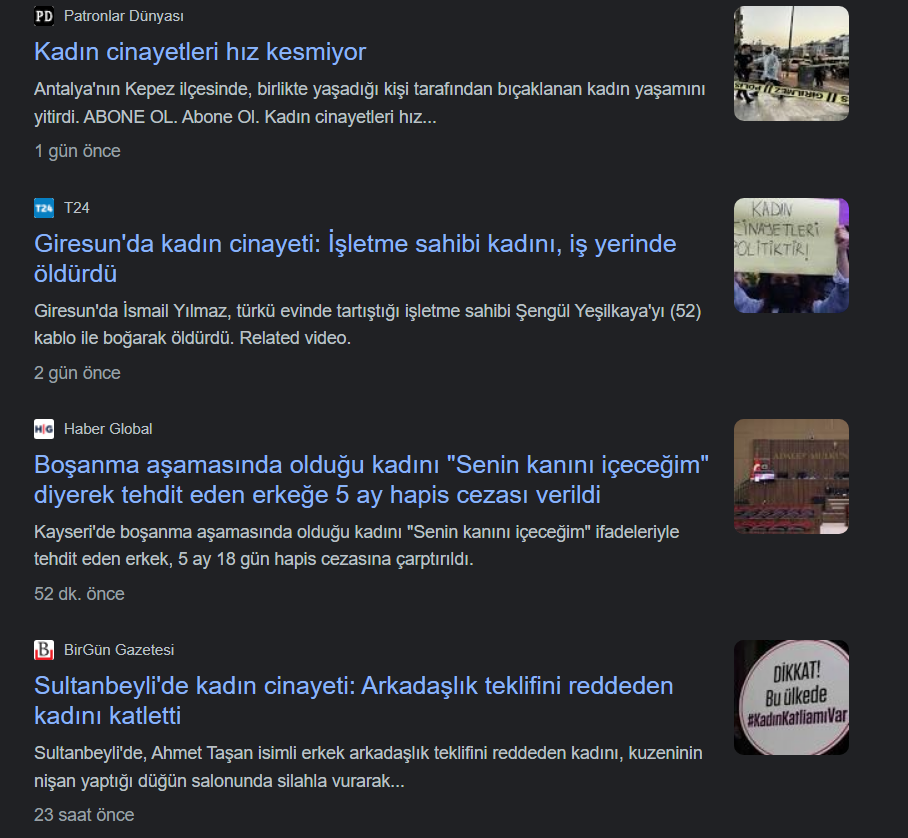
References 3-6: News Articles about Homicides in Turkey against Women
Before I finish this writing, I want to add several problems. In Turkey, some men have an addiction like alcohol. When they drink excessive amounts of alcohol, they resort to violence against their partners. But the women feel obligated to remain silent because they have a family and worry about what others will think.
Actually, these women are obligated to do this by other people. The women hear these words: “You have children, don’t be selfish.’’ “He is a man, so he can do it. Don’t care.’’ “What will you do?’’ “You are just a woman.’’ It is public pressure. Thus, these women’s families don’t support their daughters. It seems horrible actually. This causes problematic children too. Why? Because these children grow up with domestic violence. They end up having mental issues all their lives. Sometimes, these women die or are subjected to violence.
Reference 7: Federation of Women’s Associations of Türkiye (TKDF)

According to this news, Turkey is a leader for violence (Reference 8).
Another problem is that we have misogynistic thought patterns like, “women cannot work.” Some people think we should just look after our child. A woman is more than that. As I said before, we have two eyes, two legs, and two arms like a boy. I don’t want to say ‘like a boy’ actually because it looks like I support them, but I don’t. Some women’s salaries are lower than men’s salaries. The reason why is just that they are women. I can’t explain this very well, because when I’m writing this, I’m getting angry. I was working as a waitress; I know what discrimination means. They said that you can’t do this job. I know we don’t have the same bodily strengths sometimes, but we absolutely can do it, and we can even do it better. I’m sorry, but we don’t need men. We are daughters of Atatürk, and we learn to do what we want from him. Reactionist opinions don’t affect us.
To sum it up, women are in danger. I know this notion is valid all over the world, but I think this situation is on a different level in Turkey. Not just physical. I hope this situation will stop or decrease in the future.
Reference 9: Women’s Labor Force Participation Rate in Turkey

In the line graph above, it shows how women’s labor force participation rate has been increasing for years. The graph starts on February 2, 2016. Here, there was around a 34.5% participation rate and it increased to over 37% in the same year (August 8, 2016). The next year it decreased to 36% and then it steadily increased to almost 39% by October 2017. This signals how women’s labor force participation rate has been increasing in Turkey slowly.
I want to add one thing. It is about KADES. KADES is an app for women when they are in danger. Our government created it for us. It’s their solution.
I took these photos from Google and all the opinions are mine. Thanks for reading, this is written by Hayel.
All References: 1; 2; 3; 4; 5; 6; 7; 8; 9
Duru: A personal reflection on living with giftedness and ADHD
I was interested in the topic of disability in Turkey and participating in this blog because I wanted to write so badly about myself since I was in high school, and I couldn’t miss this opportunity.
There aren’t other groups like this that discuss disability in Turkey. There are people (people who have giftedness with ADHD for example), but they don’t talk about these enough. Maybe they don’t know how to talk about this disability.
I would like to add some extras before I start my writing: I have ADHD and giftedness, and the “you’’ words that I’m going to use aren’t actually about you. They are the ones used by the people who never understood me. This writing is about the screams of someone known as crazy to the real crazy people.
I was born with a gift which I pay for day by day in different ways. Since I learned this, I have a writer’s identity. I can’t be in denial, but I couldn’t reach my writing goal. I’m trying to write while not getting lost. I transformed my writing to the simplest form for you. I’m writing understandably for you. What I have done is for you anyway.
I don’t remember what my age was when I got my labels. All I can say is that especially when I was in the primary school era, these labels were increasing in the fastest way. In this era, I achieved great success.
As you will understand, the negative experiences that people have in their childhood years are trauma qualifications. Your emotions are as fresh as your age. The issue has begun here: if the child keeps being a child, his/her emotions are moved in the same way because of this. I’m not sure how many scars I can find in my soul.
To sum it up, my primary school teacher realized my giftedness first. I had impressive intelligence documented on paper, unlike parents who always see their children as geniuses. Every day, I make people question my illness. I was learning different things, unlike those at the same age. I was researching about human anatomy, about landforms, about geography, about the universe… My primary school teacher never understood me despite her realizing my giftedness. She thought I was trying to defeat her ego. I learned to write when I was four, and I already knew the things she was trying to teach me, but she was trying to defeat me all the time like I was her enemy.
When I was 8, my teacher was on a mission to pick a student from her class to join the WISC-R test. My friend from class and I were picked to join. The test had two parts, and if you passed the first part, you had gained entrance to the second part. I passed the WISC-R test, and I gained entrance to the Science and Art Center. This was a kind of course attended by gifted people. The course is named BİLSEM in Turkish, and it continued until university.
I have to say that what BİLSEM contributed to me is less than what I expected when I spent my time there. It’s full of frigid people. It had cold weather in terms of the metaphorical and literal meaning, and it had a dysfunctional system in each class. It had unsupportive guidance services. It had no idea about its students’ value. The biggest unsupportiveness was given by BİLSEM in my slipped-away childhood. I cried many times, and I produced excuses for not going there. BİLSEM’s awareness of my existence was limited to the attendance papers I received at home each year.
When I started middle school the situation transformed into another dimension. Some adolescents were trying to find their identities, fighting their hormones in there. I was trying to make friends aimlessly without knowing myself. People saw me as a person who had strange behavior, and also they didn’t understand me exactly. They were looking at me like I was an alien.
*Managing and being managed is easier than it is thought. If you know less about yourself than you think, people force you to believe in a certain way. You swallow everything; you have to swallow. You give up a version of yourself that you never knew. If you are not as raw as a lime, the people around you will carve you with blunt knives. *
In my second year of high school, I decided to quit BİLSEM, and a teacher saw me in this position. I didn’t know her. She called me over to her, and we started to have a conversation. This was the first time I saw someone who knew me more than I knew myself. She discouraged me from thinking about quitting. She was a teacher who taught gifted students and philosophy. I learned and noticed information related to giftedness thanks to her. I obtained facilities to participate in projects as well as made other gifted friends. Also, the experiences they had during their entire lives helped me to improve myself. I learned from her how I can express myself with words. I participated in a symposium organized by Prof. Ayşegül Ataman, the head of the Special Education Department at Gazi University, and I got a chance to meet the professor thanks to her. I know maybe it’s going to sound silly, but I have a laurel tattoo on my arm to remind me of her. Even though I gained information about myself from her, she abandoned me for half of my journey. She always says that we have to use our geniuses, but there is a problem we are suffering from: we don’t know how to use it, and she never educated us.
I tried to get into university twice, and I went to her to ask advice about what I was going to do for my future. She told me that I would not be able to get into a university, which I hoped that I would be able to do next time. I felt like I was never going to study enough again, and I had to try different departments. She didn’t trust me. Nevertheless, I didn’t listen to her. In the end, I got into university, and I got into the department that I wanted originally.
One year ago, I had an ADHD diagnosis, as if giftedness wasn’t enough. I started to use medicine for ADHD, which is known as Concerta. The medicine helped me better focus on what I do. But this was not enough for me. I asked my friend who had ADHD, giftedness, and Asperger’s about ADHD. He helped me notice that I am a twice-exceptional person. I realized that there are more problems to solve but also ADHD is a solution to solve my problems because it makes the problems in my life meaningful.
My dear teacher Elisa Shaholli, you provided me an opportunity to explain myself. Great thanks to you for this opportunity. All I can say is that as an ADHD person, please do not focus on your disabilities. Just focus on your extra abilities, which are gifts given by your disabilities.
Elisa: Instructor’s Conclusion
We hope that through these writings, you were able to learn more about the experiences surrounding the topic and idea of disability in a Turkish context. Through Mina’s research on health services and doctors’ experiences; Sude’s exploration on medication and economics; Hayel’s retelling on the experiences of women in Turkey– and how although being a woman is not a disability–- the barriers imposed by society on women can be disabling forces; and Duru’s personal exploration of her experience living as someone with both giftedness and ADHD and her experiences in educational institutions – we hope that these diverse perspectives can shed more light on disability in Turkey.

 Disability & Access Collective