
Written by Jaylee Cox with support from the DAC team
“I am not a superhuman ball of lightning that is a mythic ideological construction of what cocaine is, the substance changes when the person taking it becomes a vessel for that substance”
Azad Ashim Sharma, Boiled Owls, p. 37
With a diverse background in English and Creative Writing, as Director of the87press, and as a Ph.D. candidate in English and Humanities, Sharma provides a distinctive take on addiction, analyzing it through the lens of capitalism. Azad Ashim Sharma’s poetry collection, Boiled Owls, offers an expansive exploration of recovery and the societal structures memorializing addiction as a representation of capitalist ideologies, wherein the allure of social media and the entanglement with narcotics are recurrent motifs. The introspective poems extend to considerations of socialism, stemming from personal experiences with substance abuse dating back to his undergraduate years. The title itself, Boiled Owls, derives from a colloquialism, serving as a metaphor for the sense of desperation and despair inherent in addiction. The phrase can be traced back to the book’s opening poem, “The Image Is My Life,” where Sharma laments, “I shout at the people I love and lie to them when I mean to tell them the owls have boiled” (p. 3).
Sharma’s collection can be likened to the types of chocolates my father would bring back after his overseas deployments: an amalgamation of bitter and sweet that never failed to leave an impression. In a recent interview with Dante Silva, Azad Ashim Sharma stated, “If addiction is a repetitive illness where the subject makes the same choices expecting different results but ends up being left with the same carnage and pain, then I found that recovery began to seem repetitive in a different way, allowing one to experience new and exciting things.” This insightful reflection highlights both the cyclical nature and the optimistic outlook that Sharma embodies, a repetition mirrored throughout the poems of Boiled Owls.
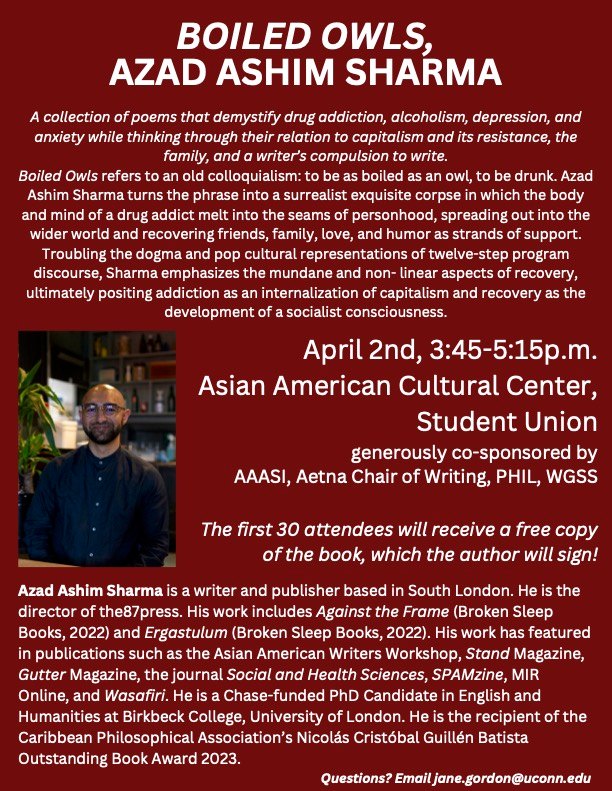
Recently, I had the pleasure of attending a poetry reading by Sharma on April 2nd at the Asian American Cultural Center at the University of Connecticut, where he captivated the audience with selections from his collection. Sharma drew parallels between the experience of substance use and poetry, likening each relapse to stripping layers away from his ego. During the reading, Professor Brueggemann, a distinguished English Professor at the University of Connecticut, detected shifts in diction and style between an intellectual and philosophical approach and then a more simple and grounded style in the poem “Planetary Death Is A Hopeless Drug Addict” (p. 22). In response, Sharma referenced the poem “Wombats Are Not Household Pets” (p. 30) and emphasized the significance of poetry not being defined by its number of accolades but by its ability to speak to people and raise their consciousness.
The themes in Boiled Owls also encompass the author’s depiction of his role as a caregiver to his 30-year-old brother, who is living with autism. These poems and moments delve into an intimate space, discussing Sharma’s bond with his brother. During the reading, Sharma revealed his and his brother’s yearly visits to the museum, which are the primary reference in the poem “Birthday Song” (p. 26). Notably, the line “Unlike typical siblings we fought in a red silence grainy with domestic neorealism” beautifully captures the departure from conventional sibling relationships. The “red silence” highlights the heightened emotions and frustrations, while “grainy with domestic neorealism” depicts the raw reality of daily life.
Sharma also delved into his relationship with his mother, particularly the impact his addiction has had on her. From discovering him covered in vomit while naked in the shower to the sleepless nights it has caused her, the poem “Xenobia” (p. 19) serves as a tribute to her, revealing the depth of their bond and the challenges she has faced concerning her relationship with his addiction. Despite their difficulties, the poem highlights the resilience of Sharma’s mother and her boundless love for her child.
Throughout the collection, Sharma presents neologisms asking us what a poem about drug use looks like in a cultural study. Mainstream culture often perpetuates misconceptions, promoting the idea that a single line of cocaine can provide limitless potential. However, the reality of cocaine addiction paints a starkly different picture, revealing the mind-altering effects and destructive consequences of substance abuse. Sharma suggests that actual substance lies not in the pursuit of fleeting highs but in being in touch with one’s humanity and embracing the values of morality and kindness. He rejects the notion that substance abuse is simply a lifestyle choice, instead framing it as a perpetual chase with devastating consequences.
Azad Ashim Sharma’s Boiled Owls is a profound work of poetry, a vision of representation and introspection. The collection boldly challenges stereotypes by authentically portraying the experiences of those wrestling with addiction and the impact on their lives. Boiled Owls reinforces the importance of representation that acknowledges and validates the diverse spectrum of human experience without conforming to predefined stereotypes or expectations. Through Sharma’s poetry, readers are offered a glimpse at the resilient nature of the human spirit and the power of literature.
References
Sharma, Azad Ashim. “Narcopoetics.” Boiled Owls, Nightboat Books, 2024, 3, 22, 30, 37.
Silva, Dante. “AN INTERVIEW WITH AZAD ASHIM SHARMA, AUTHOR OF BOILED OWLS – Nightboat Books.” Nightboat Books, 27 March 2024, https://nightboat.org/an-interview-with-azad-ashim-sharma-author-of-boiled-owls/.

 Disability & Access Collective