Written by Elisa Shaholli with support from the DAC team

For the past few months (Spring semester 2023) at the University of Connecticut, I have been working on my undergraduate senior thesis. My thesis, titled, “Religious Identity and Diabetes: A Muslim American Perspective” explores the experience of Muslim diabetics specifically within the United States, but also globally. When determining the exact structure of my thesis, interdisciplinarity was crucial for me. For a thesis centered around diabetes– located within the body but constantly being affected by factors outside of it— having research solely on one field of study felt as if justice could not be done to the topic at hand. As a result, I subdivided my thesis into three parts: one being a data analysis focused on diabetes diagnosis rates, the second being a literature review surrounding research on Muslim diabetics worldwide, and the third being a hands-on art piece.
In this blog post, I will be sharing that third portion of my thesis, an art sculpture meant to represent the experience of being a Muslim diabetic during the month of Ramadan. Personally, I have always considered art to be a therapeutic, creative outlet. What may take hundreds of words on a page can be represented using a block of clay, watercolor on canvas, or even an assortment of random items pieced together.
When considering the impact of art on disability identity as well, the effect art can have increases tenfold. Art is able to consider “the implications of the gaze, and to what extent its power can be subverted and leveraged” (Thomas). Just as it has been argued that film can provide a representational tool for disability, where it is “inspired and a product of the values, thoughts, worries, and events that occurred at the time of the image” (Shaholli), art can provide a landscape both inspired by one’s personal lived experiences and can affect other people’s perspectives. Art is especially influential because of the first-person interaction the creation process has. Whereas film tends to be created by companies and organizations and featured in spaces like movie theaters that may include barriers to entry, the creation of art is more readily accessible. This increased ability to interact with art and to create one’s own desired image enables an even more powerful tool where disability storytelling is crafted by one’s own self, rather than an outside observer (such as a film producer).
Although I’ve always enjoyed crafting and painting since I was a child, my first foray into creating artwork representing my own experience with disability only started around a year ago. For me, disability storytelling was always done in the traditional sense: get a piece of paper (or a Google Doc) and write! I began to experiment with clay artwork when I took a Disability Studies seminar during my junior year at the University of Connecticut.
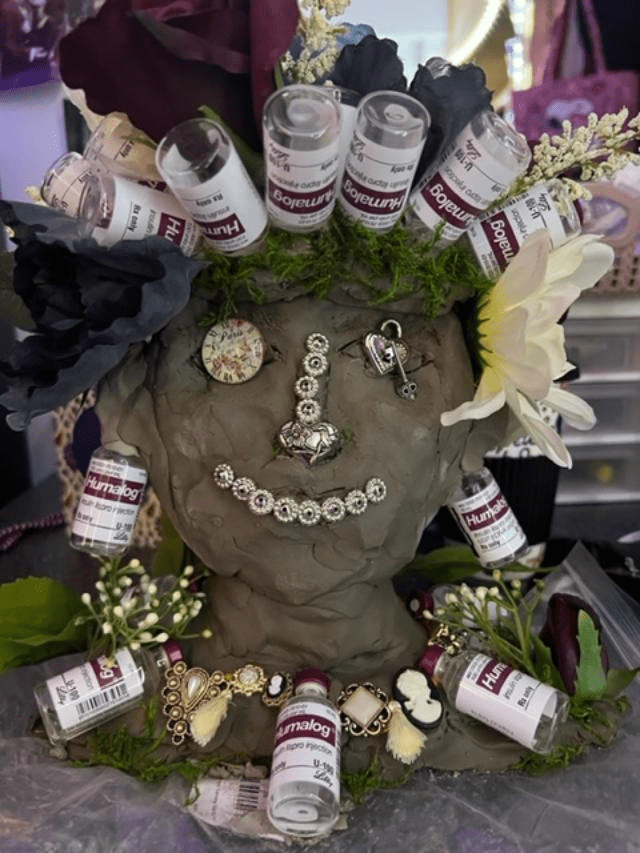
My first piece, titled Ms Excess, depicted a clay woman covered with a hair wreath of flowers and empty insulin bottles. Her earrings were empty Humalog vials, and these vials even appeared between (plastic) jewels in her necklace. I crafted Ms Excess with the archetype of the “excessive diabetic” in mind. Ms Excess was not meant to conform with the common stereotype of the self-inflicted, sugar-obsessed diabetic, but rather to subvert the meaning of excessive. With over 10 vials of insulin on the piece, Ms Excess is worth over $2,000. Just one 10 mL vial of Humalog insulin is $274.40 (Eli Lilly). Through Ms Excess, I was able to visually represent themes pertaining to the economic factors of a condition like diabetes, the importance of time, and the complexity in the relationship between the natural and the technological. If you are interested in reading more about Ms Excess, you can read about it here on the DAC Blog at Representing Diabetes with Art: Sculpting Ms Excess.
When contemplating how to craft the artwork for my thesis piece, I incorporated Tobin Siebers’s work on disability aesthetics and Bianca Frazer’s “diabetic aesthetic.” Siebers argues that “the disabled body and mind…play… significant roles in the evolution of modern aesthetics, theorizing disability as a unique resource discovered by modern art and then embraced by it as one of its defining concepts” (Siebers 2-3). Disability aesthetics is a way to prize “physical and mental difference as a significant value in itself…. It drives forward the appreciation of disability found throughout modern art by raising an objection to aesthetic standards and tastes that exclude people with disabilities” (Siebers 19).
Bianca Frazer utilizes this framework and specifically applies it to the representation of diabetes in theater. Frazer, a type one diabetic herself, describes how a diabetic aesthetic “brings together an awareness of the role of social forces combined with the emotional and physical ebb and flow of the diabetic body. It draws on the benefits of the medical model for people with chronic illness, the recognition of social barriers presented by the social model of disability and utilizes theories of embodied disability identity to imagine a new way of viewing and expressing this non-visible chronic illness in performance” (Frazer iv). Frazer argues how the creation of a diabetic aesthetic incorporates “the role of social forces in the production and experience of a diabetic body” (Frazer 4) alongside how in the expression of the emotional and physical aspects of the body, the “awareness of both social influence and the chaotic nature of the body is an example of Siebers’ notion of “complex embodiment”” (Frazer 4).
When considering an art piece that visibly represents two larger identities (Muslim and diabetic) that are otherwise invisible save for explicit markers (for example, an insulin pump for diabetics or Muslim religious wear such as, but not exclusive to, a hijab), the way to showcase a diabetic aesthetic led to many different representational challenges.
I was hesitant to create artwork that pointed and specified a specific individual feature, such as having people in the piece where choices would then have to be made surrounding the body (weight, skin tones, gender). Just as Muslims are comprised of individuals from all around the world, diabetics are as well. Because of this, I was uncomfortable creating a piece that represented a specific explicit image of an individual, as representation has power, and when one type of individual is represented, then others are left out. With that mindset then, I contemplated other ways of representing the experience of Muslim diabetics, being cognizant that no one experience can be representative of millions of individuals’ lives and identities.
For this artwork, I considered my own experiences as someone who was raised in a Muslim household and diagnosed with type one diabetes as a child. I also utilized the findings from the literature review I conducted for the second part of my thesis. For the literature review, I analyzed 13 publications surrounding Muslim diabetics. Of the 13 publications, 8 of them were primarily focused on the month of Ramadan. Although Ramadan is not the only aspect of Muslim identity, its predominance in the scholarly literature highlights how Ramadan is an especially important time for those with diabetes. Themes that I analyzed in the literature review included the complexity behind fasting– should Muslim diabetics fast? Should they fast and speak with the doctor about it? What about if the doctor doesn’t understand the concept of Ramadan? What if they fast and then they feel sick? What do you do if you don’t fast but everyone else in your family does? What about if you are told not to fast, but your personal relationship with Allah leads you to fast anyways? When Ramadan is a worldwide, month-long, widely celebrated holiday annually for Muslims, the inability to celebrate and the barriers that make celebrating difficult can provide tension within one’s own identity as a Muslim.
Bridging off of the themes found in my literature review then is my art sculpture. Crafted out of clay, my art piece holds the shape of a circle, reminiscent of a plate. This plate, however, is also a clock. As Ramadan itself is time based, so too is diabetes, with insulin dosages based on times and meals throughout the day. Throughout the hybrid clock-plate are markers representing both diabetic identity and Muslim identity. Syringes, test strips, insulin pump tubes, insulin vials, and a finger pricker point to the tools diabetics may use to care for their diabetes. Included in the piece are also popularized food items eaten during Ramadan: 3 dates represent the ending of one’s fast, 2 dessert items (lokum) comprised of sesame seeds and pistachios are included, and a clay-made piece of borek represent food that are eaten in my own household during the month of Ramadan, which can also be featured in other Muslim households.
Placement is an important theme throughout this artwork, but also within disability identity. Concerning disability, for many with medical conditions, the acquisition of a disability identity is not straightforward. The embrace of a disability identity can be met with tension. “Is (insert medical condition) even considered a disability?” is a question that individuals can ask themselves. For a condition like diabetes, the labeling of diabetes as a disability varies per individual. Scholar Aimee Burke Valeras exemplifies this in her research surrounding hidden disabilities and disability identity. In her article, “”We don’t have a box”: Understanding hidden disability identity utilizing narrative research methodology,” type one diabetic participant Brian highlights how:
“If you have a disability, there’s things you can’t do. I think people with disabilities are not able to climb Mt. Everest, as an example. I can do that. But I’ve just got to do it with a lot more caution than another person. I’m never like, “I can’t do that, I have a disability.” I’m like, “I have a disease, but I can still do that.” … And if it ever came to a point where, I guess if I had to amputate my leg because of it, I might have to change my definition of a disability. I define a disability as something you can’t do because you’re physically unable to do it… ‘Disability’ is a strong word” (Valeras).
The embrace of a disability identity for those with diabetes can then be met with hesitance, confusion, and tension. Placement within the disability community is not straightforward, and can vary by individual. The theme of placement is critical within the larger disability community as well, when considering the placement those with disabilities may have in their own families and within larger society.
Similarly, placement is a critical theme within my own art piece. Both the tools representing diabetes and the celebration of Ramadan are side-by-side, next to one another. For Muslim diabetics during this time period, both identities may conflict with one another, but can not be separated. Even if a Muslim tries to fast with diabetes, diabetes is still present when it manifests in situations such as the symptoms of hyper- or hypo- glycemia. The two syringes in this sculpture are also positioned in the format of the hands on a clock, as both Ramadan and diabetes rely on timeposts surrounding the decision to eat and the medication needed based on these decisions to eat.
Additionally, infused in this sculpture is the theme of the dichotomy between the natural and the constructed. For the tools used to treat diabetes, all are materials created and constructed by outside forces such as pharmaceutical companies. The natural, here the body, which is supposed to fulfill the process itself of breaking down food and controlling blood glucose, does not work properly (if at all). As a result of the body’s limited control over these processes, the constructed tools of syringes and pumps provide “replacements.” For the food objects, the borek is handmade out of clay while the desserts and dates are actual digestible food products. The dichotomy of the natural and the constructed in terms of food here represents the diversity in the way Ramadan is celebrated within families. Since Muslims live all around the world, the specific foods and methods of celebrations will vary between the larger community. While one family has borek, another has bread, for example. Foods can be eaten in their natural way, such as eating a date with no extra ingredients added to it. Food could also be constructed by hand though, through cooking a new recipe from start to finish.
Frazer’s diabetic aesthetic which “considers both the limits imposed by social barriers and the possibilities opened by individual embodied experiences” (Frazer 150) is at the heart of this artwork. This sculpture considers the tension between fulfilling both aspects of one’s identity during a time when it feels as if both identities are in complete tension with one another. Even with the tension, however, both identities live side-by-side, simultaneously and can not be separated. Although traversing diabetes during Ramadan may pose challenges, this piece was made to represent the experience of the many diabetic Muslims who do elect to fast.
Process:
Outlined below is a visual diary behind the process of crafting the sculpture for my thesis.

First, I began by drafting ideas in a notebook. I knew I did not want a piece that was specific in representation of one individual and ignorant of another, so I wanted to stay away from constructing a piece that was human-like (where I would then have to decide how the body would look like). Having finished most of the reading and analysis for the literature review I included in my thesis by this point in time, I thought of the predominant themes that appeared there for inspiration. Ramadan was a central focus, and one that was a facet of identity for all Muslims. With Ramadan in mind, I began thinking of the most important factors of being a Muslim during the time of Ramadan. The process of fasting, the food and the blood sugars that follow, the impacts of fasting when having to also take medication based on eating when you should not be eating, the importance of time…. All these were themes that popped into my mind. With that, the plate came immediately to me, since that’s where all the meals are. The clock followed after, considering how crucial timing is for fasting and for medication. As for items, I thought of diabetic supplies I wouldn’t mind parting with: expired test strips, syringes I had many of, a broken glucometer, and empty insulin vials. For Ramadan foods, dates are always crucial as they are used to break a fast. For Ramadan and other religious holidays, desserts and handmade foods like borek were always commonplace items in my household. I had drafted many other food items as well (meats, fruits), but my plate was only so large!

I first got an empty lid from a cookie jar to help create a solid, foundational circle. I covered the entire lid with clay to begin the process of creating the plate.

After letting the clay dry around the lid, I began decorating the plate. I didn’t use any specific colors, but rather aimed to make a joyous design. Ramadan is a celebration, and at least in my household, celebrations always mean utilizing the fanciest plates we have at home.

The crescent and star were placed in the middle of the plate to symbolize Islam. This symbol is seen in country flags such as those of Pakistan’s and Turkey’s, both of which are Muslim majority countries, and is highly associated with an Islamic identity.

I crafted the “handmade” piece of borek out of clay after painting the plate. The black lines represent sesame seeds, and the green on the sides represent spinach!

After getting the borek done, I placed the wooden numbers of 12, 3, 6, and 9 on the plate in order to mimic a traditional clock.

Finally came the addition of the other objects into the piece! I knew I wanted the syringes to echo hands on a clock, but all other objects were included in terms of spacing and also connectivity. I didn’t want one side to be with all diabetic supplies and the other with Ramadan food items. Since both identities are connected and can’t be separated, so too are the objects since they are right near each other!
References
Frazer, Bianca Claire. Diabetic Aesthetic: from Stigmatizing Diabetes to Acknowledging the Lived Experience on Stage. 2019. University of Colorado Boulder CU Scholar University Libraries, https://scholar.colorado.edu/concern/graduate_thesis_or_dissertations/6969z089x.
Shaholli, Elisa. “Disability in a Galaxy Far, Far Away: A Mythology of Villains, “Obsessive Avengers,” and Complex Embodiments in Star Wars.” Disability Studies Quarterly, vol. 42, no. 1, 2022. Disability Studies Quarterly, https://doi.org/10.18061/dsq.v42i1.8024. Accessed 6 May 2023.
Siebers, Tobin. Disability Aesthetics. Ann Arbor: University of Michigan Press, 2010.Valeras, Aimee. ““We don’t have a box”: Understanding Hidden Disability Identity Utilizing Narrative Research Methodology.” Disability Studies Quarterly, vol. 30, no. 3/4: Disability and/in Time, 2010. Disability Studies Quarterly, https://doi.org/10.18061/dsq.v30i3/4.1267. Accessed 6 May 2023.

 Disability & Access Collective